What is Reverse Osmosis & How Does it Work?

What is the first word that comes to your mind when you think of water purification or water purifiers?
I am not that good at reading minds but I think I have read your mind pretty well.
Didn’t you just think of ‘RO’?
Yes?
See, apart from reviewing water purifiers, I can now try my hands on mind reading.
Well, jokes apart.
I didn’t get this one right because of my sharp mind-reading skills.
I got it right because I have years of experience and a fair understanding of the water purification market and consumer preferences.
Reverse Osmosis (RO) has become as synonymous with water purification as Colgate is to toothpaste and Baba Ramdev is to Yoga.
Reverse Osmosis water purifiers have become so popular in India that you hear people referring to every home water purifier as ‘RO’ and purified water as ‘RO water’.
But, do you know what Reverse Osmosis technology is and how it works?
Should you blindly buy an RO purifier?
Worry not!
This article will answer all your queries in simple terms.
You’ll have a much better understanding of Reverse Osmosis technology by the time you reach the end of this article.
That’s a GUARANTEE!
What is Reverse Osmosis?
Reverse Osmosis is one of the most effective water purification technologies. It gives you clean, pure, and safe water that tastes great.
Reverse osmosis (RO) is a water purification process that uses a semi-permeable membrane to filter out dissolved solids, microorganisms, and larger particles from drinking water.
Did that sound too technical?
Let’s make it easy to understand.

In reverse osmosis, water is pushed through a semi-permeable membrane (RO membrane) that allows only water molecules to pass through and filters out everything else.
What is Semi-Permeable Membrane?
How Does Reverse Osmosis Work?
Before I throw any light on how reverse osmosis technology works.
Let’s first understand the process of osmosis.
Osmosis is basically the passage of water molecules through a semi-permeable membrane that blocks particles and dissolved solids present in the water. The water moves from a low concentration area to a high concentration area passing through a barrier due to the surrounding osmotic pressure.
Osmotic Pressure
In other words, under osmosis, if you put highly contaminated water and less contaminated water on either side of a semi-permeable membrane then less contaminated water (low concentration area) will pass through the membrane and move towards highly contaminated water (high concentration area).
Take a look at the image given below. This explains the process of osmosis quite easily.

It is quite clear that osmosis in its standard form can’t be used for water purification.
Why would you take less contaminated water, filter it, and then mix it with highly contaminated water?
What if you reverse this process?
Take highly contaminated water, filter it, and then mix it with pure or less contaminated water.
Now you are starting to think in the right direction.
Wait!
What happens to the osmotic pressure then?
This villain will never let that happen.
You’ll have to find a hero that knocks out this villain.
That hero has to have more powers, pressure in this case.
That hero is an external pressure that is much stronger than the natural osmotic pressure.
There you are.
Under high pressure, the osmosis process gets reversed i.e. the solution now flows through a semi-permeable membrane from high concentration to low concentration.
This is reverse osmosis in most simple terms.
The image given below explains the process of reverse osmosis so beautifully.
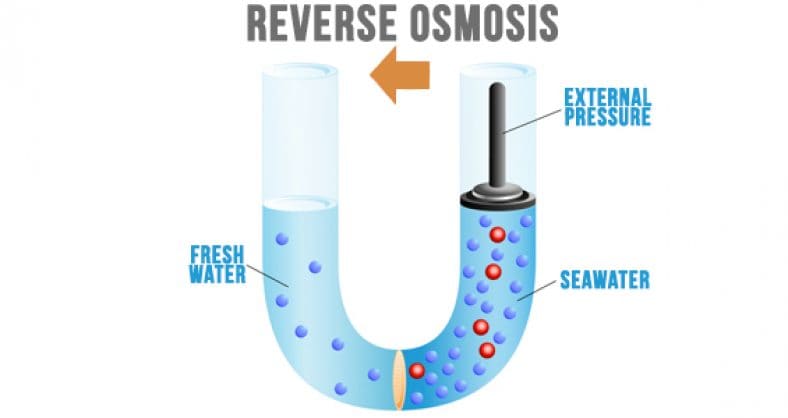
The semi-permeable membrane used in reverse osmosis purification has hundreds or thousands of pores as small as .0001 microns.
These minute pores only allow water molecules to pass through and filter out everything else.
That’s why RO purification is considered the most reliable water purification technology.
History of Reverse Osmosis
Before I spill the beans.
Can you guess when was reverse osmosis invented?
The mid-1950s.
Yes, you read that right.
It might look like one of the latest technologies.
But the truth is, that researchers from the University of California and the University of Florida successfully used reverse osmosis to produce fresh water from seawater in the mid-1950s.
In 1977, the municipal corporation of Cape Coral, Florida, first used reverse osmosis on a large scale for public water distribution.
Advantages of Reverse Osmosis
- Reverse Osmosis is the most reliable form of water purification. It is the only water purification technology that filters out such a broad range of contaminants ranging from dust particles, chlorine, microorganisms, and harmful chemicals, to dissolved solids and heavy metals.
- Reverse Osmosis is the only home water purification technology that turns high TDS, salty, and hard water into soft, sweet-tasting water.
- Protects you from infections and waterborne diseases.
- RO purified water is the best alternative to costly bottled water.
- RO purification is a fully automated process. All you have to do is just turn the system, everything else is taken care of by the purifier.
Click to read: Can You Use RO Water in Battery?
Disadvantages of Reverse Osmosis
- RO purification results in huge water wastage. Traditional RO systems can waste as much as 3 glasses of water for every glass of purified water they produce.
- Both, the initial cost and the maintenance costs are high.
- The process is quite slow, even the most efficient home RO systems can hardly provide 20-25 litres of purified water per hour. Most RO systems available in India produce around 10-12 litres of purified drinking water per hour. But that’s more than sufficient for most homes.
- Requires periodic replacement of filters and membrane, you can’t fit and forget.
- Does not disinfect water. RO purification can remove some bacteria but it should not be relied upon to remove 100% of bacteria and viruses
What Contaminants Does Reverse Osmosis Remove?
I think that’s the wrong question to ask.
The question that should be asked is ‘What contaminants do reverse osmosis not remove?’
What all does the reverse osmosis system remove…
- Dissolved solids like Calcium, Magnesium? Yes.
- Salt? Yes.
- Dust, Dirt, and Sediment? Yes.
- Chlorine? Yes.
- Heavy metals like Lead & Arsenic? Yes.
- Herbicides and pesticides? Yes.
- Bacteria and Viruses? No. Reverse osmosis may remove some bacteria, but RO purification does not provide 100% safety against microbial contamination from bacteria and viruses. For removing microorganisms like bacteria and viruses, UV disinfection is recommended. That’s why most RO purifiers also feature a UV purification stage.
Do Reverse Osmosis Systems Waste Water?
All reverse osmosis systems produce two types of water. The first is the purified water that is stored in the purifier tank for drinking, and the second is the rejected water that is discarded.
The wastewater or rejected water carries all the contaminants removed during reverse osmosis purification.
Generally, you view this as unnecessary waste.
Right?
I also used to think that way until recently.
When I read an interesting view from one of the leading water purification experts in the USA.
He said ‘The wastewater is not being wasted without any cause. This wastewater is used for a purpose. The wastewater in an RO system is being used for purifying your drinking water.’
Would you call the water that is thrown out by your washing machine after cleaning your clothes wastewater?
What would you call the water that goes down the drain after bathing or washing utensils?
Most definitely, your answer would be ‘this water is not wasted but used for cleaning’.
Right.

In the same way, the water that comes out of an RO system is used for cleaning/purifying your drinking water.
Seems logical to me.
What do you think about this thought? Do let us know in the comments section.
Still, it’s our moral responsibility to not only use efficient RO systems that save more water but also to reuse RO wastewater for other tasks.
Is Reverse Osmosis Water Bad for You?
Critics of RO purifiers often project them as villains. And all of them have two arguments in support of their claims.
- Wastage of water
- Demineralization of water
We have discussed the first argument just above.
Now coming to the second claim.
There is absolutely no doubt that, along with all the harmful contaminants, a reverse osmosis system also removes essential minerals like calcium and magnesium.
That’s because an RO membrane can’t differentiate between good contaminants and bad contaminants.
But does that make RO water bad?
There is no doubt that your body needs essential minerals.
But water is not the primary source of these minerals. The primary source of these minerals is food, fruits, and green vegetables.
If water was the primary source, you would have to drink too much water to meet the recommended dietary allowance: Calcium: 1000 mg/day, Magnesium: 400 -420 mg/day (approximate values).
Drinking water with some essential minerals is acceptable, but the Bureau of Indian Standards (BIS) recommends that the ideal TDS level of drinking water should not be more than 500 PPM. Unfortunately, a large part of India, especially those that depend on groundwater for drinking, has TDS levels above 500 PPM.
Reverse Osmosis water is also good for your kidneys and is recommended for people with Kidney disorders like stones etc.
This leaves RO purification as the only alternative for the purification of water.
Cutting the long story short.
Reverse Osmosis does remove minerals, but this should not be the cause of your worries as we have just seen right above.
But, always remember, we do not recommend blindly buying an RO purifier.
If you would like to learn more about which water purifier to buy, please read this informative post.
Wrapping Up
Like with all things in life, reverse osmosis, does have a few limitations.
But the benefits of reverse osmosis far outweigh these small limitations.
And it is high time, that some people stop projecting this life-saving water purification technology as a villain all the time.
I hope this post has cleared many of your doubts and questions about reverse osmosis. If you still have any queries, please feel free to leave a comment below and we’ll try to answer in 24 hours.