What is Reverse Osmosis & How Does it Work?
What is the first word that comes to your mind when you think of water purification or water purifiers?

I am not that good at reading minds but I think I have read your mind pretty well.

Didn’t you just think of ‘RO’?

Yes?

See, apart from reviewing water purifiers, I can now try my hands on mind reading.

Well, jokes apart.

I didn’t get this one right because of my sharp mind-reading skills.

I got it right because I have years of experience and a fair understanding of the water purification market and consumer preferences.

Reverse Osmosis (RO) has become as synonymous with water purification as Colgate is to toothpaste and Baba Ramdev is to Yoga.

Reverse Osmosis water purifiers have become so popular in India that you hear people referring to every home water purifier as ‘RO’ and purified water as ‘RO water’.

But, do you know what Reverse Osmosis technology is and how it works?

Should you blindly buy an RO purifier?

Worry not!

This article will answer all your queries in simple terms.

You’ll have a much better understanding of Reverse Osmosis technology by the time you reach the end of this article.

That’s a GUARANTEE!

What is Reverse Osmosis?

Reverse Osmosis is one of the most effective water purification technologies. It gives you clean, pure, and safe water that tastes great.

Reverse osmosis (RO) is a water purification process that uses a semi-permeable membrane to filter out dissolved solids, microorganisms, and larger particles from drinking water.

Did that sound too technical?

Let’s make it easy to understand.

ro water purifying process

In reverse osmosis, water is pushed through a semi-permeable membrane (RO membrane) that allows only water molecules to pass through and filters out everything else.

What is Semi-Permeable Membrane?

A semipermeable or selectively permeable membrane is a layer (or group of layers) that allows only certain molecules to pass through it but not others.

How Does Reverse Osmosis Work?

Before I throw any light on how reverse osmosis technology works.

Let’s first understand the process of osmosis.

Osmosis is basically the passage of water molecules through a semi-permeable membrane that blocks particles and dissolved solids present in the water. The water moves from a low concentration area to a high concentration area passing through a barrier due to the surrounding osmotic pressure.

Osmotic Pressure

The natural pressure due to which any slightly concentrated solution moves through a semi-permeable membrane towards a highly concentrated solution.

In other words, under osmosis, if you put highly contaminated water and less contaminated water on either side of a semi-permeable membrane then less contaminated water (low concentration area) will pass through the membrane and move towards highly contaminated water (high concentration area).

Take a look at the image given below. This explains the process of osmosis quite easily.

Osmosis Process

It is quite clear that osmosis in its standard form can’t be used for water purification.

Why would you take less contaminated water, filter it, and then mix it with highly contaminated water?

What if you reverse this process?

Take highly contaminated water, filter it, and then mix it with pure or less contaminated water.

Now you are starting to think in the right direction.

Wait!

What happens to the osmotic pressure then?

This villain will never let that happen.

You’ll have to find a hero that knocks out this villain.

That hero has to have more powers, pressure in this case.

That hero is an external pressure that is much stronger than the natural osmotic pressure.

There you are.

Under high pressure, the osmosis process gets reversed i.e. the solution now flows through a semi-permeable membrane from high concentration to low concentration.

This is reverse osmosis in most simple terms.

The image given below explains the process of reverse osmosis so beautifully.
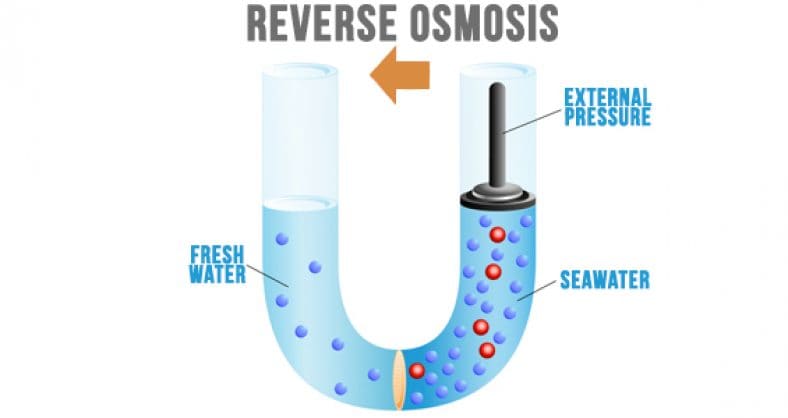
The semi-permeable membrane used in reverse osmosis purification has hundreds or thousands of pores as small as .0001 microns.

These minute pores only allow water molecules to pass through and filter out everything else.

That’s why RO purification is considered the most reliable water purification technology.


Confused about different purification technologies like RO, UV, UF, and MF? Read this article for a complete understanding of how they work.

History of Reverse Osmosis

Before I spill the beans.

Can you guess when was reverse osmosis invented?

The mid-1950s.

Yes, you read that right.

It might look like one of the latest technologies.

But the truth is, that researchers from the University of California and the University of Florida successfully used reverse osmosis to produce fresh water from seawater in the mid-1950s.

In 1977, the municipal corporation of Cape Coral, Florida, first used reverse osmosis on a large scale for public water distribution.

Advantages of Reverse Osmosis

  • Reverse Osmosis is the most reliable form of water purification. It is the only water purification technology that filters out such a broad range of contaminants ranging from dust particles, chlorine, microorganisms, and harmful chemicals, to dissolved solids and heavy metals.
  • Reverse Osmosis is the only home water purification technology that turns high TDS, salty, and hard water into soft, sweet-tasting water.
  • Protects you from infections and waterborne diseases.
  • RO purified water is the best alternative to costly bottled water.
  • RO purification is a fully automated process. All you have to do is just turn the system, everything else is taken care of by the purifier.

Click to read: Can You Use RO Water in Battery?

Disadvantages of Reverse Osmosis

  • RO purification results in huge water wastage. Traditional RO systems can waste as much as 3 glasses of water for every glass of purified water they produce.
  • Both, the initial cost and the maintenance costs are high.
  • The process is quite slow, even the most efficient home RO systems can hardly provide 20-25 litres of purified water per hour. Most RO systems available in India produce around 10-12 litres of purified drinking water per hour. But that’s more than sufficient for most homes.
  • Requires periodic replacement of filters and membrane, you can’t fit and forget.
  • Does not disinfect water. RO purification can remove some bacteria but it should not be relied upon to remove 100% of bacteria and viruses

What Contaminants Does Reverse Osmosis Remove?

I think that’s the wrong question to ask.

The question that should be asked is ‘What contaminants do reverse osmosis not remove?’

What all does the reverse osmosis system remove…

  • Dissolved solids like Calcium, Magnesium? Yes.
  • Salt? Yes.
  • Dust, Dirt, and Sediment? Yes.
  • Chlorine? Yes.
  • Heavy metals like Lead & Arsenic? Yes.
  • Herbicides and pesticides? Yes.
  • Bacteria and Viruses? No. Reverse osmosis may remove some bacteria, but RO purification does not provide 100% safety against microbial contamination from bacteria and viruses. For removing microorganisms like bacteria and viruses, UV disinfection is recommended. That’s why most RO purifiers also feature a UV purification stage.

Do Reverse Osmosis Systems Waste Water?

All reverse osmosis systems produce two types of water. The first is the purified water that is stored in the purifier tank for drinking, and the second is the rejected water that is discarded.

The wastewater or rejected water carries all the contaminants removed during reverse osmosis purification.

Generally, you view this as unnecessary waste.

Right?

I also used to think that way until recently.

When I read an interesting view from one of the leading water purification experts in the USA.

He said ‘The wastewater is not being wasted without any cause. This wastewater is used for a purpose. The wastewater in an RO system is being used for purifying your drinking water.’

Would you call the water that is thrown out by your washing machine after cleaning your clothes wastewater?

What would you call the water that goes down the drain after bathing or washing utensils?

Most definitely, your answer would be ‘this water is not wasted but used for cleaning’.

Right.

In the same way, the water that comes out of an RO system is used for cleaning/purifying your drinking water.

Seems logical to me.

What do you think about this thought? Do let us know in the comments section.

Still, it’s our moral responsibility to not only use efficient RO systems that save more water but also to reuse RO wastewater for other tasks.

Is Reverse Osmosis Water Bad for You?

Critics of RO purifiers often project them as villains. And all of them have two arguments in support of their claims.

  1. Wastage of water
  2. Demineralization of water

We have discussed the first argument just above.

Now coming to the second claim.

There is absolutely no doubt that, along with all the harmful contaminants, a reverse osmosis system also removes essential minerals like calcium and magnesium.

That’s because an RO membrane can’t differentiate between good contaminants and bad contaminants.

But does that make RO water bad?

There is no doubt that your body needs essential minerals.

But water is not the primary source of these minerals. The primary source of these minerals is food, fruits, and green vegetables.

If water was the primary source, you would have to drink too much water to meet the recommended dietary allowance: Calcium: 1000 mg/day, Magnesium: 400 -420 mg/day (approximate values).

Drinking water with some essential minerals is acceptable, but the Bureau of Indian Standards (BIS) recommends that the ideal TDS level of drinking water should not be more than 500 PPM. Unfortunately, a large part of India, especially those that depend on groundwater for drinking, has TDS levels above 500 PPM.

Reverse Osmosis water is also good for your kidneys and is recommended for people with Kidney disorders like stones etc.

This leaves RO purification as the only alternative for the purification of water.

Cutting the long story short.

Reverse Osmosis does remove minerals, but this should not be the cause of your worries as we have just seen right above.

But, always remember, we do not recommend blindly buying an RO purifier.

If you would like to learn more about which water purifier to buy, please read this informative post.

Wrapping Up

Like with all things in life, reverse osmosis, does have a few limitations.

But the benefits of reverse osmosis far outweigh these small limitations.

And it is high time, that some people stop projecting this life-saving water purification technology as a villain all the time.

I hope this post has cleared many of your doubts and questions about reverse osmosis. If you still have any queries, please feel free to leave a comment below and we’ll try to answer in 24 hours.
 

The Ultimate Guide for Buying A New Water Purifier

We’re pretty sure you’re convinced that every penny you spend on a great water purifier is a penny spent wisely, because of the health benefits of drinking purified and uncontaminated water.

Even apart from that, there are dozens of reasons for you to look for the best water purifier and get one home; for instance, water purifiers ensure:

  • Safety from life-threatening waterborne diseases that may be caused by contaminated water
  • That weird taste of chlorine and calcium carbonate is removed from tap water (which means it won’t spoil your coffee!)
  • Little to zero scratchings, spotting, and scaling on the surface of your kitchen utensils.

Things to Look for When Buying a New Water Purifier

Water Purifier Buying Guide 2026

This Water Purifier Buying Guide will help you identify the right water purifier for your home or office; read on.

Before we discuss the different types of water purification technologies and which one of these suits your needs, it is important to first understand the different types of impurities found commonly in drinking water. Because then only we’ll be able to understand the need for such varied types of water purifiers.

Different Types of Impurities Found Commonly in Drinking Water

The type of impurities found in the drinking water coming to your home mainly depends on the source and distribution medium of water. The most common sources of drinking water are: lakes, rivers, bore wells, harvested rainwater, piped municipal corporation supply, water tankers, etc.

The quality of water, level of impurities like harmful pollutants, and chemicals, biological impurities like bacteria and viruses, and hardness, all depend on the source of water.

Most common types of impurities in water:

TYPE OF IMPURITY MOST COMMON WATER SOURCE EFFECT ON DRINKING WATER
Un-dissolved solids such as sand and mud River, borewell, or piped water where pipes are damaged Muddy or turbid appearance
Dissolved inorganic salts like Sodium & Potassium Borewells and seawater Salty or brackish taste
Dissolved inorganic salts like Sodium and potassium Borewells and river water Hardness and scale formation
Organic compounds Lakes and ponds Foul smell or bad odor
Disinfectants like Chlorine Municipal piped water supply Bitter taste
Biological impurities like bacteria & viruses Piped water where pipes are damaged, water tankers Biological contamination, waterborne diseases

Usually, water from lakes, rivers, and harvested rainwater will have a low TDS level (Total Dissolved Solids) as compared to water from bore wells.

Borewell or groundwater generally has high TDS and may also contain harmful chemical impurities like lead, arsenic, etc.

Piped water supply or water stored in tanks is generally more prone to biological contamination (if the pipes are damaged or the storage tanks are not cleaned frequently).

Identify the Water Type – Soft or Hard Water

Water can be classified as soft or hard based on the level of dissolved solids in water. Total Dissolved Solids (TDS) is regarded as the degree of hardness and are measured in units of Parts Per Million (PPM) or Milligrams per Litre (mg/L).

1 ppm = 1 mg/L

Water with TDS values ranging between 150-300 ppm is considered to be soft water, while water with a TDS value higher than 500 ppm is considered to be hard or contaminated water.

Must Read

What’s the source of the water you get supplied to your home?

If it comes from underground water, supplied by water tankers, or drawn from deep-dug bore wells, then most probably it’s hard water.

Now, hard water contains pretty high percentages of dissolved solids like calcium, magnesium, heavy metals, fluorides, and arsenic. All these dissolved impurities make hard water unfit for human drinking.

On the other hand, water sourced from rivers, rainwater harvesting systems, lakes, and municipality-managed storage and delivery systems is generally termed soft water. Soft water, though not as dangerous, also needs purification before it can be deemed safe for human consumption in the long run.

You may also like: How to Make Hard Water Soft

Water Purifier Types, and Mapping Them to Your Water Type

1. Reverse Osmosis (RO) Purifiers
To understand the workings of RO, we need to first understand what Osmosis is.

In the normal osmosis process, the water naturally flows from an area of low solute concentration (low TDS level), through a membrane, to an area of high solute concentration (high TDS level).

The pores of the membrane are very small (about 0.0001 microns), water molecules being smaller are allowed to pass through and the smallest dissolved impurities and bacteria are trapped.

As the name suggests, Reverse Osmosis (RO) does the opposite of Osmosis, that is, pushing the water molecules from the region of higher TDS level to the region of lower TDS level. This is achieved by applying external pressure with the help of a water pump to reverse the natural flow of water.

Water with impurities or high TDS is pumped at high pressure into the RO chamber, this pushes the water molecules across the semi-permeable membrane to the other side while leaving the dissolved solids and other impurities behind.

All the dissolved solids and impurities along with some input water, also known as RO wastewater, are discharged through a separate outlet.

RO purifiers are therefore always recommended for purifying water that has a high TDS level. The TDS level of the output drinking water from the RO purifier is very low as compared to the input water.

Some Drawbacks of RO Technology

  • Requires Electricity: A high-pressure electrical water pump is used to apply external pressure on the input water, hence RO purifiers cannot work without electricity.
  • Wastes Water: A significant part of the input water is discharged along with the dissolved impurities, which results in unnecessary wastage of water. On average, RO purifiers produce 3 litres of wastewater for every 1 litre of purified water.

2. Ultrafiltration (UF)

Like RO, Ultrafiltration also uses a semi-permeable membrane to purify water.

After reading the first sentence, you must now be thinking if both RO and UF use the same method to purify the water then what is the difference between RO and UF?

Ultrafiltration or UF uses a membrane with much larger pores (appx. 0.01 microns) as compared to RO which uses a membrane with very small pores (appx. 0.0001 microns).

The advantage of using Ultrafiltration is that UF purifiers can work without electricity because the membrane has much larger pores and water can pass through it naturally using the force of gravity. This means no external pressure or water pump is required. Also, since UF purifiers do not hold back any water, there is no wastage of water.

However there are some limitations to using UF purifiers, because of larger pore size, UF can only remove undissolved solids and larger impurities. It cannot remove the dissolved solids or reduce the TDS level. So, UF purifiers are not suitable for the purification of high TDS water or hard water.

3. Ultraviolet (UV) Purification
As the name suggests, Ultraviolet or UV purification uses ultraviolet rays for the purification of water.

A UV purifier works by throwing high-intensity UV rays on the water which kills or inactivates the disease-causing bacteria and viruses.

However, UV purifiers cannot remove any dissolved or un-dissolved impurities or chemicals from water.

Because of this most of the UV purifiers that are available in the market use sediment filters to remove undissolved impurities and an activated carbon filter to remove Chlorine and some dissolved impurities.

Therefore, UV water purifiers are only recommended for areas where the water source has a low level of TDS.

If the water has a low TDS level but is contaminated with bacteria and viruses and appears muddy then you can use a UF+UV water purifier.

4. Tap/Faucet Mounted Filters or Gravity-Based Purifiers
These types of filters or purifiers are the simplest to use and provide the most basic water purification.

These filters generally comprise sediment or sediment + activated carbon filters which can remove large and un-dissolved impurities like mud and sand along with some chemicals and microorganisms. Tap/Faucet Filters are very small in size and can be directly fitted on taps.

Gravity-based storage purifiers are the advanced version of tap/faucet filters. These purifiers offer slightly advanced purification and come with an in-built storage tank to store input/impure water.

Most of the Gravity-based water purifiers available in the Indian market now have 2 separate storage tanks for input/impure and output/purified water.

Tap/Faucet Mounted Filters and Gravity Based Purifiers are only suitable for areas where the TDS level is low and water is not highly contaminated with biological impurities like bacteria, viruses, and other disease-causing germs.

Which Water Purifier Should I Choose?

RO technology has become synonymous with water purifiers and you must have heard a lot of people referring to water purifiers as RO (like the brand Xerox has become synonymous with photocopying).

Because of this, when we talk about buying a water purifier most people think RO water purifiers should be purchased by default without considering the most important facts like the source of water and TDS level of input water.

If you have read all the above discussion then you are well aware of the fact that RO purification is required only when the water coming to your home or office has a high TDS value (generally higher than 500 ppm).

These days there are different kinds of water purifiers available in the market ranging from simple tap/faucet filters and Gravity-based purifiers to UF, UV, RO, and their combinations. This vast range of different technologies and hundreds of different water purifier models from various brands have increased the complexity of buying the right purifier for your home or office.

Useful Link

You may also like to read the difference between RO vs UV vs UF.

As discussed earlier, you should buy an RO purifier only if the water to be purified has a high TDS level. The Bureau of Indian Standards (BIS) has specified the maximum TDS limit for safe drinking water as 500 ppm.

There is absolutely no need to use an RO purifier if the TDS level is below 500 ppm. Because if your water source has low TDS then the RO purifier will further reduce it to a very low TDS level. This means the purified water will then be devoid of essential minerals like calcium and magnesium which are required for our good health.

If the TDS level of incoming water is below 500 ppm then you should check the incoming water for turbidity (clarity), muddy appearance, or the presence of biological impurities like bacteria and viruses.

Though water purifier makers try to differentiate their products from competitors by flaunting advanced water purification technologies, most of them use a mix of three major purification approaches – Reverse Osmosis (RO), Ultraviolet (UV), and UF (Ultrafiltration).

If you do not want to go into the technicalities of the different purification approaches, then you can simply refer to the below checklist that will help you buy the right purifier for your home or office.

The table given below lists all the parameters to evaluate and choose the right water purifier according to your needs.

TDS LEVEL IS WATER MUDDY? PRESENCE OF BIOLOGICAL IMPURITIES? IDEAL CHOICE
Below 500 ppm No No Gravity-Based Purifiers
Below 500 ppm No Yes UV
Below 500 ppm Yes No UF
Below 500 ppm Yes Yes UF or UF+UV
Over 500 ppm No No RO
Over 500 ppm No Yes RO+UV
Over 500 ppm Yes No RO+UV or RO+UV+UF
Over 500 ppm Yes Yes RO+UV+UF


Not sure about the quality of water at your home? You can now get it tested by a Government-approved water testing lab near your home.
  • Soft water has a low TDS level; UF water purifiers work pretty well for it.
  • For soft water with a high level of biological contamination, go for a UV or UF+UV water purifier.
  • Hard water contains a higher level of TDS, apart from specific toxins; so, RO purifiers are well suited for purifying it.
  • For hard water with a high level of biological contamination, go for an RO+UV or RO+UV+UF water purifier.
  • UF filters are best used in combination with another water purification system, as they don’t kill any microorganisms in contaminated water. UF filters only remove suspended solids from water.
  • Activated carbon-based water purifiers are ideally suited to remove excess chlorine from water.

Important Note

Please note that there is one exception to the above rules.

If the water contains harmful heavy metals like lead, arsenic, mercury, etc., then you must choose an RO purifier regardless of the TDS level of the water.

This is so because only the RO membranes can get rid of these contaminants.

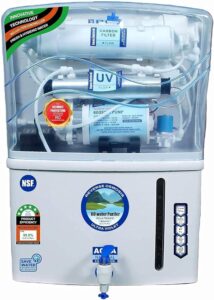
Main Components of RO Water Purifier

  • Sediment Pre-filter: In the first stage of purification, the input water is filtered using a pre-sediment filter. Pre-sediment filter not only removes fine and coarse particulate impurities/dirt but also improves the life of the RO/UF membrane resulting in a lower cost of maintenance. If the purifier does not include this as a standard feature then it can be added separately as well.
  • Activated Carbon Pre-filter: Activated carbon pre-filter removes chlorine and organic impurities like harmful pesticides from the water. Activated carbon pre-filter also adsorbs bad odor and taste-causing organic compounds from water.
  • RO/UF membranes: Water is fed into the RO membrane at high pressure using an in-built water pump. RO membrane removes the hardness, dissolved salts, pesticides, and heavy metals like lead, arsenic, and mercury. It also removes microbial contaminants like viruses, bacteria, protozoa, and cysts. The UF membrane also works like the RO membrane but it does not remove the dissolved solids. Some purifiers use both RO and a UF membrane, the output water from both membranes is mixed to control the TDS level of purified water.
  • TDS controller: The TDS controller is used for controlling the TDS level of the output water. RO process not only removes bad impurities but also removes essential minerals like Calcium and Magnesium. TDS controller retains adequate quantities of essential minerals in the purified water by adjusting the ratio of water from the RO membrane (low TDS) and UF membrane (normal TDS) in the final mix.
  • UV Filter: A UV filter uses a high-intensity UV bulb to kill or inactivate any virus, bacteria, and parasites to deliver safe water.
  • Carbon Post-filter: Carbon Post-filter acts as a polisher and enhances the taste of purified water. It also removes any foul smell from water.
  • Storage Tank: This stores the purified water for later use. Make sure the storage tank is made of food-grade, non-toxic material. Some of the high-end water purifiers now come with a stainless steel water storage tank. You should also check the capacity of the storage tank.
  • Display: Most of the RO water purifiers come with a basic display for on/off, tank full, etc. Some advanced purifiers also come with fault alerts, filter change alerts, UV fail, TDS level indicators, purity indicators, etc.

Gravity-Based Water Purifiers – Where Do They Fit In?

Good question. Considering they’re inexpensive and effective, it’s natural that these filters excite a lot of interest, especially among first-time buyers of water purifiers. Now, these filters don’t deliver advanced water purification capabilities such as RO and UV-based filters. So, the only scenarios where they become practical options are:

  • When you don’t have optimum conditions for the installation of an electric water purifier, such as optimum water pressure, electricity, and running water supply.
  • When you need to switch homes frequently and don’t want to have bulky equipment to move around and re-install every time.
  • When you have a very limited budget.

In such situations, you could either choose to buy purified water in bulk from a convenience store or install a gravity-based water purifier.

Installation Feasibility of Water Purifiers

Most RO and UV-based water purifiers are bulky and pretty heavy. Before you buy one, make sure you know of its dimensions, and have a plan to have it wall-mounted in the kitchen area. You will need to provide an inlet for electricity and another for water. Also, there must be a continuous water supply at decent pressure, particularly when the water purifier is mounted high on a kitchen wall.

Reducing and Reusing RO Waste Water

Avoid using an RO water purifier if the TDS level of the input water is below 500 mg/L and the water does not contain any harmful heavy metals like lead, arsenic, and mercury. In such a case, using a UV+UF water purifier would be more appropriate. Save water by not using RO water purifiers if RO purification is not necessary.

An average RO purifier wastes approximately 3 litres of water for every 1 litre of purified water. That means only 25% of water is purified and 75% of water comes out as waste.

Shocked?

It’s true. This high percentage of water wastage is a major cause of worry. If you are also using an RO water purifier at your home or office then we request you to follow the below-given tips to reduce the wastage of water and re-use the wastewater generated by RO purifiers.

  • If the output water from your purifier has very low TDS (less than 150) then it means your purifier is generating more wastewater. A very low level of TDS not only results in higher wastage of water but it is also bad for our health as it is devoid of essential minerals. Increasing the TDS will not only make drinking water healthier but also reduce waste. You can increase the TDS level of your water purifier using the TDS controller knob.
  • Store and re-use the RO waste water.

Final Thoughts

The sole and biggest criteria for deciding the type of water purifier you should buy are the source of water and the kind of impurities present in the water supplied to your home or office. Use the suggestions shared in this water purifier buying guide to buy a new water purifier for your home or office.