Livpure has become a leading brand in the water purifier industry in a very short period.
Livpure, a part of SAR Group, is a company that is well known for its quality appliances like water purifiers and air purifiers. Livpure offers water purification solutions for both home and commercial use.
Livpure now offers a complete range of water purifiers starting from basic gravity-based water purifiers to high-end multi-stage RO water purifiers with advanced features like touch control and Bluetooth.
Good features, quality purification, great prices, and reliable installation and service support are the main reasons why Livpure has become a trusted name in the water purifier market.
Livpure is also among the best-selling water purifier brands on all the leading online stores like Amazon and Flipkart.
Livpure is the first leading brand of water purifiers to offer RO on rent through its Livpure Smart RO Subscription service.
Here is the best-selling Livpure water purifier price list updated on: October 17th, 2025.
Why Choose Livpure RO Purifiers?
There are various models and different price ranges of Livpure water purifiers in the Indian market.
Livpure’s advanced purification mechanism ensures that dirt, parasites, bacteria, viruses, dissolved solids, and other harmful substances are effectively removed from the water.
Livpure has a wide range of purifiers to match the varying water purification needs of Indian customers. If you are looking for a portable non-electric water purifier then you can choose from Livpure’s gravity-based water purifiers and if you are looking for advanced purification then Livpure’s range of UV and RO purifiers is all you need.
Unique Features of Livpure Water Purifiers
Attractive and affordable prices
Advanced & reliable purification
Clean and intelligent design
Huge nationwide sales & support system
Full range of water purifiers
Customer-friendly and reliable service support
Livpure Customer Services
Livpure has a country-wide presence with more than 10000 retail partners and 300 distributors. Livpure is also exporting its world-class water purifiers to over 15 countries across the globe. Livpure offers strong nationwide support with its 46 special hubs, 1450 service centers, and over 450 service engineers across the country.
Livpure’s on-ground customer support is really good and has been appreciated by customers.
Livpure Customer Care Number
Make a call on the Toll-Free customer service number – 1800 – 419 – 9399
Write an e-mail to customer care support – customercare@livpure.com
If you are planning to buy a new RO water purifier and have done some research online or offline then you must have come across some RO purifiers that come with an extra feature called ‘TDS Controller’ or MTDS.
It is also interesting to note that this same feature is sometimes marketed as a ‘TDS Modulator’ by some water purifier brands.
However, TDS Controller, MTDS, and TDS Modulator are one and the same thing and there is no functional difference between each of them.
Different manufacturers use different terms for the same feature or functionality.
While Kent uses the term ‘TDS Controller”, Aquaguard or Eureka Forbes uses the term MTDS (Manual Total Dissolved Solids Controller).
But they all perform absolutely the same function.
What the heck is this TDS Controller/MTDS?
The following text will answer all your questions about the TDS controller in an easy and user-friendly manner.
Let’s begin then.
What is a TDS Controller or MTDS in Water Purifier?
In simple terms, a TDS Controller or MTDS is a device that controls the TDS (Total Dissolved Solids) of water. Unlike the filters, cartridges, and membrane(s), TDS Controller does not filter or purify the water in any way.
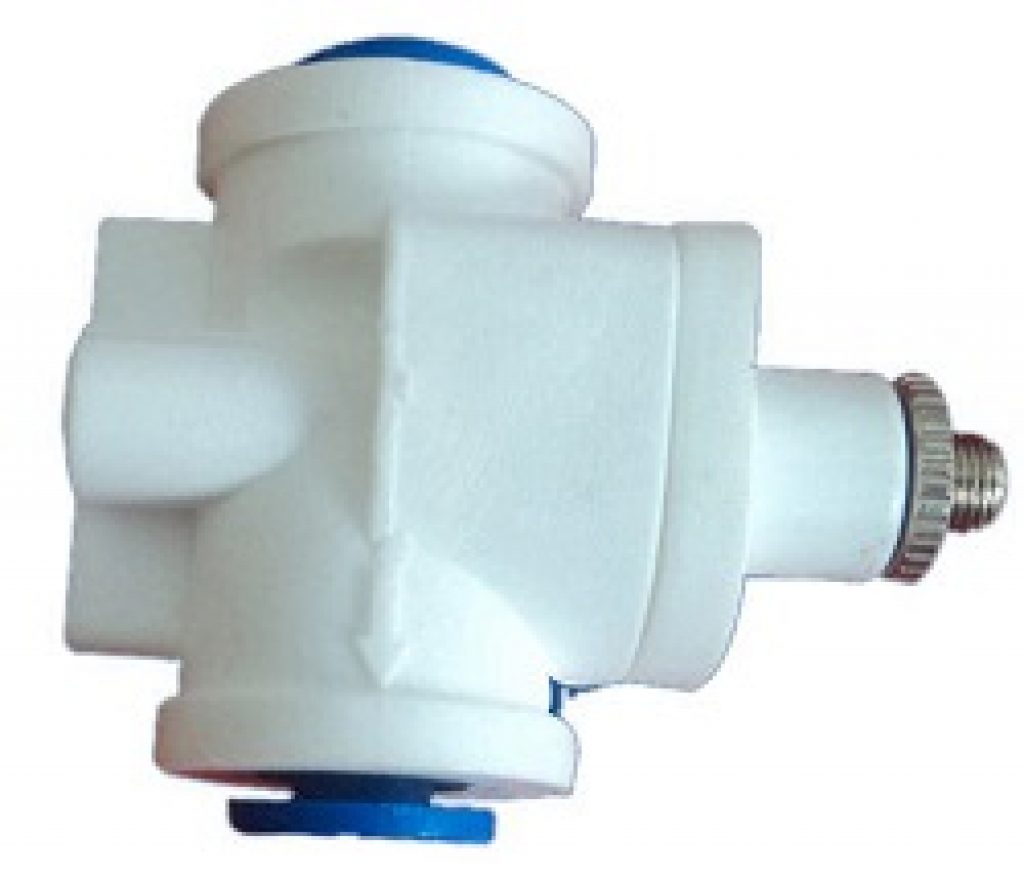
The image above shows a typical TDS controller, as you can see this is a small device. This is quite inexpensive and costs roughly around Rs. 50 only.
How TDS Controller Works?
TDS Controller or MTDS is basically a manual device that consists of two water inputs, one water output, and a TDS Control screw.
Water Input 1: Purified water output from the RO membrane
Water Input 2:
a) Purified Water from Activated Carbon Filter in case of RO+UV+TDS Controller Water Purifiers
OR
b) Purified Water from UF Membrane in case of RO+UF+UV+TDS Controller or RO+UF+TDS Controller Water Purifiers
Water Output: Mix of two water inputs in the required ratio.
TDS Control Screw: TDS Control screw controls the TDS value in output water by manually adjusting the flow of water from the two water inputs.
I) If TDS needs to be reduced then the flow of input water from the RO membrane is increased and the flow of input water from the Activated Carbon Filter or UF membrane is reduced.
II) If TDS needs to be increased then the flow of input water from the RO membrane is reduced and the flow of input water from the Activated Carbon Filter or UF membrane is increased.
Simply, Turn the screw clockwise to reduce the TDS level or anti-clockwise to increase the TDS level.
Please note, in most RO purifiers, TDS Controller is located inside the assembly along with all other RO parts. So for adjusting the TDS level, you will have to first open the outer cover.
However, if you are not comfortable doing this, we recommend getting this done by a trained professional.
Recommended TDS Level in Drinking Water?
You should adjust the TDS controller such that the TDS level of purified water is between 80 to 150 ppm.
Natural water contains several essential minerals like Calcium, Magnesium and may also contain harmful impurities like heavy metals, fluorides, and arsenic.
These minerals and heavy metals are what constitute ‘Dissolved Solids’ in water. The level or the presence of these Dissolved Solids in water is commonly referred to as the TDS (Total Dissolved Solids) level of water.
The presence of minerals like calcium and magnesium in small quantities is what makes the drinking water healthy and it is very essential that the drinking water contains these minerals.
RO Membranes usually remove around 90% of dissolved solids from the input water, and that includes essential minerals.
What this essentially means is, if the input water does not have high TDS then chances are the RO Membranes will reduce the level of essential minerals to a significantly low level making the water unhealthy and not fit for drinking.
This is where the role of the TDS Controller comes into effect. As detailed above, in such a scenario when theowaterpur TDS level of the input water is not so high, TDS Controller can be used to increase the TDS of purified water to a healthy level.
The TDS Controller is basically used to increase the level of essential minerals in the purified water.
TDS Controller: Can it be Harmful?
In our opinion, the TDS Controller or MTDS is not an ideal way to add essential minerals to purified water. In RO purifiers with a TDS controller, 100% of the input water does not pass through the RO membrane.
Mixing RO purified water with non-RO purified water may result in the presence of several harmful heavy metals like lead and arsenic in the purified water, as these impurities can only be removed by an RO membrane.
Should you Buy an RO with TDS Controller or MTDS?
Keeping all the above discussion in mind, you should only consider buying an RO purifier with TDS Controller or MTDS if:
• The TDS Level of input/raw water is low (lower than 900 ppm).
• Water does not contain heavy metals like lead and arsenic.
If the TDS level of the raw/input water is high (higher than 900 ppm) or if the water contains harmful heavy metals then you should not choose an RO purifier with TDS Controller.
The above recommendation is given on the basis of the RO membrane reduces the TDS level by 90%. The lower and higher TDS level limits will change if the RO membrane reduces the TDS level by more or less than 90%.
Be sure to check the specifications of the RO membrane before deciding to buy an RO purifier with TDS Controller or without TDS Controller.
Which Water Purifier with TDS Controller to Choose?
Now, if you have zeroed in on buying an RO purifier with TDS Controller then the following table will help you in finding the perfect match for your home.
TDS LEVEL IS WATER MUDDY? PRESENCE OF BIOLOGICAL IMPURITIES? IDEAL CHOICE
500 – 900 ppm No No RO+TDS Controller/Mineralizer
500 – 900 ppm No Yes RO+UV+TDS Controller/Mineralizer
500 – 900 ppm Yes No RO+UF+TDS Controller/Mineralizer or RO+UV+UF+TDS Controller/Mineralizer
500 – 900 ppm Yes Yes RO+UV+UF+TDS Controller/Mineralizer
Over 900 ppm No No RO
Over 900 ppm No Yes RO+UV
Over 900 ppm Yes No RO+UF or RO+UV+UF
Over 900 ppm Yes Yes RO+UV+UF
Is there any Better Alternative to TDS Controller?
There are now better technologies available to add back the essential minerals removed by RO purification.
RO purifiers with Mineralizer cartridges are a much better option as compared to RO purifiers with TDS Controllers. Because in RO purifiers with Mineralizer feature, 100% of the water passes through the RO membrane. This removes any possible chances of harmful dissolved solids and heavy metals accidentally entering your drinking water.
The next section talks about Mineralizer, the difference between TDS Controller and Mineralizer, and which one is better.
What is Mineralizer or Mineral Cartridge?
RO Membrane does not differentiate between the good particles and the bad particles/impurities. And this is one of the disadvantages of using an RO purifier.
RO also removes essential minerals like calcium and magnesium from the water, so we need some way to add back the minerals removed during RO purification.
One way of doing that is by using a TDS Controller/Modulator, we have already discussed this in detail above.
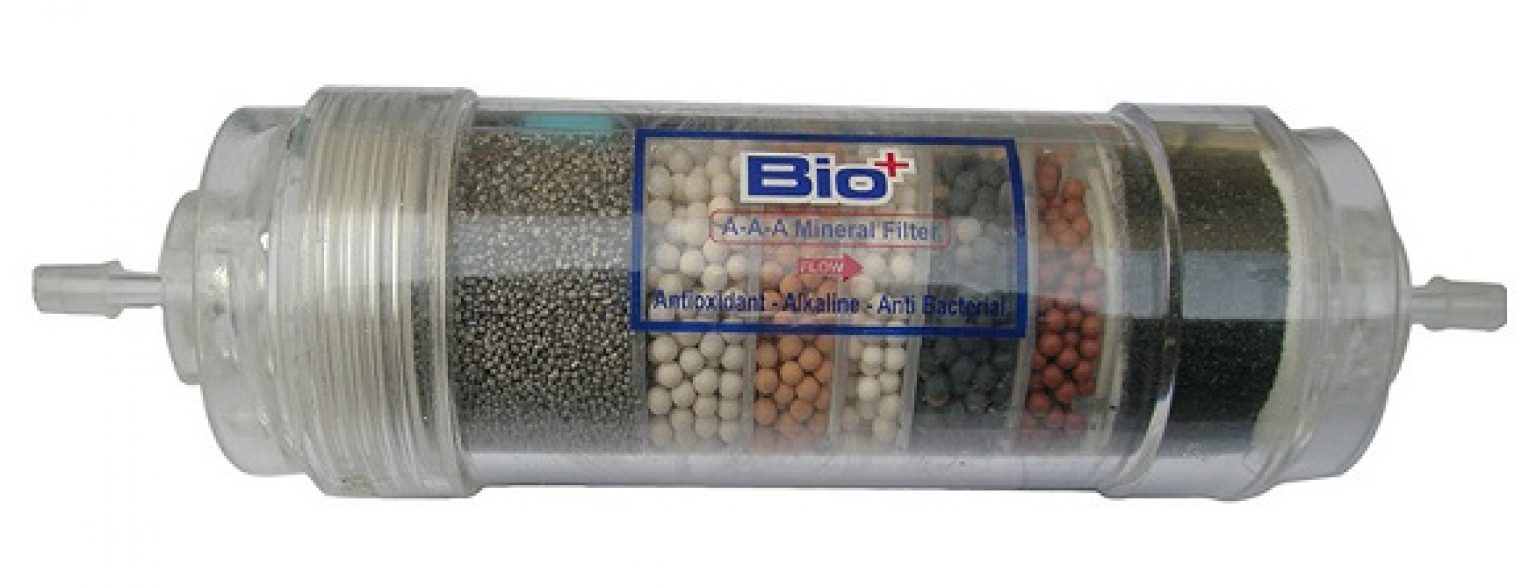
Another, slightly more effective, way to add essential minerals is ‘Mineralizer or Mineral Cartridge’.
Mineralizer or Mineral Cartridge adds back essential minerals like Magnesium and Calcium in the proper concentration and helps in maintaining proper PH and Acid-alkaline balance in the water.
Below is an image of a typical mineral cartridge:
As you can see in the image above, the mineralizer (AKA Mineral Cartridge) consists of several types of particles. Water passes from one end to the other and several essential minerals are added, and the acidic nature of water is reduced by balancing the PH value.
Difference Between TDS Controller and Mineralizer?
TDS CONTROLLER/MTDS:
100% of the input water is not passed through RO Membrane.
Not ideal for water containing harmful heavy metals like lead and arsenic.
TDS Levels of purified water can be increased or decreased.
Small and costs very little.
MINERALIZER/MINERAL CARTRIDGE:
100% of the input water is purified by RO Membrane.
Since 100% water passes through RO purification, heavy metals like lead and arsenic are removed.
No option to control the TDS level of purified water.
The size is the same as regular filters and cartridges used in RO purifiers, costing over Rs. 500.
Mineralizer or TDS Controller, Which One is Better?
Both Mineralizer and TDS Controller features are quite useful and provide excellent benefits if used appropriately.
If the water supply contains industrial impurities like lead and arsenic then you should avoid buying an RO purifier with TDS Controller. Apart from that, RO purifiers with TDS Controllers work well in most scenarios.
RO purifiers with the Mineralizer feature can be used for water infected with lead and arsenic but these purifiers have no option to adjust the TDS level as per your requirement.
So, the answer to the question ‘Whether to choose an RO purifier with TDS Controller or Mineralizer’ would actually depend on the factors like the presence of industrial impurities and your choice.
However, we feel RO purifiers with the mineralizer feature have a little upper hand as compared to the RO purifiers with the TDS Controller feature.
The unmindful wastage of clean drinking water is one of the most serious threats in front of the world.
We have compiled a big list of very useful and motivational save water slogans that can create much-needed awareness about saving water in your daily life.
These quotes and slogans will not only motivate you but you can also use them to spread awareness in your society. These save water quotes will also add that x-factor in your speech on saving water or the essay for your school assignment.
Below listed are some of the best quotes and slogans on saving water. We have handpicked these quotes and slogans from various sources and created beautiful posters for popular Save Water slogans.
Here are some inspirational save water quotes and slogans.
Please share these slogans and posters with your friends and spread awareness about the importance of water conservation.
Popular Save Water Slogans and Quotes
#1 – Save Water, Save Life
Save Water, Save Life
#2 – Thousands Have Lived Without Love, Not One Without Water. – W.H.Auden
Thousands have lived without love, not one without water. – W.H.Auden
#3 – No Water. No Life. No Blue. No Green. – Sylvia Earle
No Water. No Life. No Blue. No Green. – Sylvia Earle
#4 – Water is Life. Don’t Waste It.
Water is Life. Don’t Waste It.
#5 – Keep Calm & Drink Water.
Keep Calm & Drink Water.
#6 – Water is Your Best Friend for Life.
Water is Your Best Friend for Life.
#7 – Pure Water is the World’s First and Foremost Medicine. – Slovakian Proverb.
Pure Water is the World’s First and Foremost Medicine. – Slovakian Proverb
#8 – Clean Water Should be a Necessity.
Clean Water Should be a Necessity.
#9 – THINK, You Can’t do anything without water. Save it.
THINK, You Can’t do anything without water. Save it.
#10 – Water is the Best Natural Remedy. Drink Your Way to Better Health.
Water the Natural Remedy. Drink Your Way to Better Health
#11 – Water is Life and Clean Water Means Health – Audrey Hepburn
Water is Life and Clean Water Means Health – Audrey Hepburn
#12 – Water is the Driving Force of All Nature – Leonardo da Vinci
Water is the driving force of all nature – Leonardo da Vinci
#13 – Drink Pure Water. Stay Healthy.
Drink Pure Water. Stay Healthy.
#14 – Improve Your Water. Improve Your Life.
Improve Your Water. Improve Your Life.
#15 – Drink More Water. Pure Water.
Drink More Water. Pure Water.
#16 – Water Used to Be Fresh, Pure, and Drinkable, Now the Water Has Lots of Focal Matter and Bacteria – Claudine Sierra
Water used to be fresh, pure, and drinkable, now the water has lots of focal matter and bacteria – Claudine Sierra
#17 – There is No Small Pleasure in Pure Water – Ovid
There is no small pleasure in pure water – Ovid
#18 – When the Well is Dry, We’ll Know the Worth of Water – Benjamin Franklin
When the well is dry, we’ll know the worth of water – Benjamin Franklin
Slogans on Water Conservation – Complete List
Save water before it’s too late.
SAVE WATER the world is in your hands.
Save water, and it will save you.
Nothing will be left here without water.
A slogan on Water is a slogan for life.
Water taught lessons that the rest of the world could not.
Use water but never waste water!
Water is a gift from the creator, Protect it! Respect it!
No matter, how rich you are, you can’t live without water.
Do the Earth a favor, Be a water saver
Today’s rainwater is tomorrow’s lifesaver so think outside the sink!
Do your children a favor and save tomorrow’s lifesaver. WATER!
Save water and save the earth
If we don’t learn to conserve, we’ll all be fish out of the water, and You Know the Result!!
Water is life, Treat it right!
You never know the worth of water until the taps run dry.
Every drop counts!
Every drop of water matters
Pure water runs life!
Pure water = better life. Don’t ruin it.
Save water and tell others to do so
Let’s be a water saver!!!
Life starts with water
You will look for water on the moon because the earth is going to be waterless soon.
We need your helping hand, to save water, sky, and land.
Water is a Priceless Gift of Nature, so Save it for the Future.
Whether rich or poor; everyone needs water.
If we care for it, It will care for us.
Water covers two-thirds of the surface of the Earth, but Freshwater is only 0.002% of Earth.
Wanted: Water in its natural form
Water is more precious than Gold.
You are 70% water. Save 70% of YOURSELF
I don’t waste water – Do you?
Go green & Drink clean
Use your brain to save water even from the rain.
Without water you are nothing.
Put a STOP to the Water DROP.
Please stop that drip
Slow the flow Save H2O
Water Smarter!
Be Water Wise!
Be a Water Hero!
Think outside the sink!
Do you harvest rainwater? If not, start today!
Save water… it doesn’t grow on trees.
Don’t forget to save water, otherwise, water will forget you one day.
Don’t waste even a drop of water otherwise, you will be finished for a drop of water.
Without water, survival is impossible
Life is impossible without water
You can’t live without water
Save water and secure the future!
Save Water to Save this Planet.
Water is the soul of the earth, don’t separate both.
Keep the water crystal clear or your kids will shed a tear.
Every drop of clean water is important to us.
Let’s all do our share to conserve water with care.
For those who conserve, a Big thank you is deserved!
Wasting water is a BAD idea!
Save water, It’s a Big Deal!
Be aware, and use it with care!
Wait, stop and think, what if we didn’t have water to drink? Save it Now.
Don’t let the water run in the sink, our life’s on the brink!
It will be a BIG problem if we waste our water.
Don’t let this chance fly away. Save Water!
SAVE WATER – Don’t waste the world’s blood.
Conserve Those You Love, The Things That Matter, What Keeps You Living! Save Water!
Water conservation is the key to a sustainable future for you and me.
When not in use don’t let the water flow, You must conserve the H2O.
Our ecosystems depend on water, Don’t waste it!
You don’t know its true worth until it is gone. SAVE WATER.
Water is the driver of Nature. Please save it.
Water – A priceless treasure, Save it with pleasure.
One good action repeated a million times creates global change.
It’s a good thing to know, how to conserve H2O.
You have the power to turn off the faucet and the shower.
Saving water can be tons of fun!
Water: The liquid that sustains life, Conserve it!
Saving water is a good deed, it’s an essential resource, we all need!
If not now? then when? Save water before you see it end.
If we care for Water Now, It will care for us in the Present and Future.
Don’t let me spot you wasting water!
Don’t forget to save water. I’m watching you!
The choice is yours- Save it or Waste it.
Water preservation to prevent future devastation.
Before it all wastes away, let’s start conserving water today!
Save Water. It’s not just a drop in the bucket. It’s a Life
Save water every day, and keep scarcity always away.
Life on earth would not exist without water.
The bright future begins with clean water.
Water is precious but its availability is serious.
If you don’t want mental hydration then think about water conservation.
The less you use, the more you save.
Don’t waste water, so we can have it another day.
Don’t drop out to save the drop.
A drop of water is worth more than a sack of gold to a thirsty man.
Store water for Dry days!
Save water; it will save you later.
When you conserve water, you conserve life!
Life depends on water, the reservoir depends on you.
Save water every day and keep disasters away.
Water pollution is a bad solution.
Want life or death, you choose! Stop water pollution!
Clean water is a blessing from God, don’t pollute it.
Say no to water pollution and lead a healthy life.
Water is to drink not pollute and waste
Say no to water pollution!
Love water, Hate pollution
Protect Your Water Bodies From Pollution.
Water: The original NO calorie drink.
There are several ways to save water. And, they all start with you.
Always remember to fill the glass up to the need.
More water, more happiness.
Put a stop to the drop.
A Drip can Destroy many Drops.
Please Think and don’t Waste Water in the Sink.
Don’t let the water run when you brush your teeth.
Turn off the faucet while brushing your teeth.
Save Some Water for mankind, Close the tap, and don’t be blind.
Close the water tap after use always.
It’s no fun to let the water run.
Save water flush less.
It’s all about water!
There is a thin line between using water and wasting water.
How many drops make up an ocean? Conserve water; every drop counts.
Imagine a day without water
Waste water today – Live in the desert tomorrow.
Walk in the desert, you will realize the cost of Water.
Go to a desert to learn the importance of water
We never know the worth of water till the well is dry. Save Water!!
Waterless planets have no life.
What if you stopped drinking water?
Never throw away drinking water; always save it to have later.
Start water conservation to prevent future dehydration.
Save water! Your small step can be a major change.
Be a real human being and save the water from your end.
If you don’t know, ask the importance of water to a thirsty man.
Teach your kids to respect water so that they can have it later.
The rainwater tank, won’t break the bank.
A Gallon Saved is a Gallon Earned
The wars of the twenty-first century will be fought over water.
The water you pollute will find its way back to you.
Don’t flush our planet’s most valuable resource.
Conserve water, every drop counts!
Save water today, use it tomorrow
Destroy water, you destroy life.
Don’t make nature cry, keep your water clean.
Water is the most critical resource issue of our lifetime and our children’s lifetime.
Even a drop can bring life! Save water!
The best gift you can give to the coming generation is water.
Saving water is in our hands.
The habit of saving water is the best
Save water, it’s our most valuable resource
Save water, do your part
Save water for your bright future
Save water, the world depends on it
Saving water can save the world
No Water – No Life
Conserve water, conserve life.
Water is the substance of life. Treasure it!
Water is not the source of life, it is life.
If Water is Life, then why we are wasting it?
We forget that the water cycle and the life cycle are one.
Water is a human right!
Water, the beauty of nature
Think Blue and go Green!
It takes a lot of blue to stay green.
WATER, the DNA of life
Water = Life, Conservation = Future!
There are no substitutes for water.
Water, a wonder liquid
Water is sacred. Kindly save it.
Water for the future generations… Priceless.
Water, water everywhere but not a drop to drink.
One drop could save our thirsty world! Conserve Water!
Water is the one substance from which the earth can conceal nothing, it sucks out its innermost secrets and brings them to our very lips.
Think of water conservation to prevent it from extinction.
Use water only when you need it, like costly things.
Water is to save, otherwise, you will crave.
These are the best save water slogans and quotes for encouraging people to understand the importance of water conservation.
Before we discuss the different types of water purification technologies and which one of these suits your needs, it is important to first understand the different types of impurities found commonly in drinking water. Because then only we’ll be able to understand the need for such varied types of water purifiers.
Different Types of Impurities Found Commonly in Drinking Water
The type of impurities found in the drinking water coming to your home mainly depends on the source and distribution medium of water. The most common sources of drinking water are: lakes, rivers, bore wells, harvested rainwater, piped municipal corporation supply, water tankers, etc.
The quality of water, level of impurities like harmful pollutants, and chemicals, biological impurities like bacteria and viruses, and hardness, all depend on the source of water.
Most common types of impurities in water:
TYPE OF IMPURITY
MOST COMMON WATER SOURCE
EFFECT ON DRINKING WATER
Un-dissolved solids such as sand and mud
River, borewell, or piped water where pipes are damaged
Muddy or turbid appearance
Dissolved inorganic salts like Sodium & Potassium
Borewells and seawater
Salty or brackish taste
Dissolved inorganic salts like Sodium and potassium
Borewells and river water
Hardness and scale formation
Organic compounds
Lakes and ponds
Foul smell or bad odor
Disinfectants like Chlorine
Municipal piped water supply
Bitter taste
Biological impurities like bacteria & viruses
Piped water where pipes are damaged, water tankers
Biological contamination, waterborne diseases
Usually, water from lakes, rivers, and harvested rainwater will have a low TDS level (Total Dissolved Solids) as compared to water from bore wells.
Borewell or groundwater generally has high TDS and may also contain harmful chemical impurities like lead, arsenic, etc.
Piped water supply or water stored in tanks is generally more prone to biological contamination (if the pipes are damaged or the storage tanks are not cleaned frequently).
Identify the Water Type – Soft or Hard Water
Water can be classified as soft or hard based on the level of dissolved solids in water. Total Dissolved Solids (TDS) is regarded as the degree of hardness and are measured in units of Parts Per Million (PPM) or Milligrams per Litre (mg/L).
1 ppm = 1 mg/L
Water with TDS values ranging between 150-300 ppm is considered to be soft water, while water with a TDS value higher than 500 ppm is considered to be hard or contaminated water.
What’s the source of the water you get supplied to your home?
If it comes from underground water, supplied by water tankers, or drawn from deep-dug bore wells, then most probably it’s hard water.
Now, hard water contains pretty high percentages of dissolved solids like calcium, magnesium, heavy metals, fluorides, and arsenic. All these dissolved impurities make hard water unfit for human drinking.
On the other hand, water sourced from rivers, rainwater harvesting systems, lakes, and municipality-managed storage and delivery systems is generally termed soft water. Soft water, though not as dangerous, also needs purification before it can be deemed safe for human consumption in the long run.
Water Purifier Types, and Mapping Them to Your Water Type
1. Reverse Osmosis (RO) Purifiers
To understand the workings of RO, we need to first understand what Osmosis is.
In the normal osmosis process, the water naturally flows from an area of low solute concentration (low TDS level), through a membrane, to an area of high solute concentration (high TDS level).
The pores of the membrane are very small (about 0.0001 microns), water molecules being smaller are allowed to pass through and the smallest dissolved impurities and bacteria are trapped.
As the name suggests, Reverse Osmosis (RO) does the opposite of Osmosis, that is, pushing the water molecules from the region of higher TDS level to the region of lower TDS level. This is achieved by applying external pressure with the help of a water pump to reverse the natural flow of water.
Water with impurities or high TDS is pumped at high pressure into the RO chamber, this pushes the water molecules across the semi-permeable membrane to the other side while leaving the dissolved solids and other impurities behind.
All the dissolved solids and impurities along with some input water, also known as RO wastewater, are discharged through a separate outlet.
RO purifiers are therefore always recommended for purifying water that has a high TDS level. The TDS level of the output drinking water from the RO purifier is very low as compared to the input water.
Some Drawbacks of RO Technology
Requires Electricity: A high-pressure electrical water pump is used to apply external pressure on the input water, hence RO purifiers cannot work without electricity.
Wastes Water: A significant part of the input water is discharged along with the dissolved impurities, which results in unnecessary wastage of water. On average, RO purifiers produce 3 litres of wastewater for every 1 litre of purified water.
2. Ultrafiltration (UF)
Like RO, Ultrafiltration also uses a semi-permeable membrane to purify water.
After reading the first sentence, you must now be thinking if both RO and UF use the same method to purify the water then what is the difference between RO and UF?
Ultrafiltration or UF uses a membrane with much larger pores (appx. 0.01 microns) as compared to RO which uses a membrane with very small pores (appx. 0.0001 microns).
The advantage of using Ultrafiltration is that UF purifiers can work without electricity because the membrane has much larger pores and water can pass through it naturally using the force of gravity. This means no external pressure or water pump is required. Also, since UF purifiers do not hold back any water, there is no wastage of water.
However there are some limitations to using UF purifiers, because of larger pore size, UF can only remove undissolved solids and larger impurities. It cannot remove the dissolved solids or reduce the TDS level. So, UF purifiers are not suitable for the purification of high TDS water or hard water.
3. Ultraviolet (UV) Purification
As the name suggests, Ultraviolet or UV purification uses ultraviolet rays for the purification of water.
A UV purifier works by throwing high-intensity UV rays on the water which kills or inactivates the disease-causing bacteria and viruses.
However, UV purifiers cannot remove any dissolved or un-dissolved impurities or chemicals from water.
Because of this most of the UV purifiers that are available in the market use sediment filters to remove undissolved impurities and an activated carbon filter to remove Chlorine and some dissolved impurities.
Therefore, UV water purifiers are only recommended for areas where the water source has a low level of TDS.
If the water has a low TDS level but is contaminated with bacteria and viruses and appears muddy then you can use a UF+UV water purifier.
4. Tap/Faucet Mounted Filters or Gravity-Based Purifiers
These types of filters or purifiers are the simplest to use and provide the most basic water purification.
These filters generally comprise sediment or sediment + activated carbon filters which can remove large and un-dissolved impurities like mud and sand along with some chemicals and microorganisms. Tap/Faucet Filters are very small in size and can be directly fitted on taps.
Gravity-based storage purifiers are the advanced version of tap/faucet filters. These purifiers offer slightly advanced purification and come with an in-built storage tank to store input/impure water.
Most of the Gravity-based water purifiers available in the Indian market now have 2 separate storage tanks for input/impure and output/purified water.
Tap/Faucet Mounted Filters and Gravity Based Purifiers are only suitable for areas where the TDS level is low and water is not highly contaminated with biological impurities like bacteria, viruses, and other disease-causing germs.
Which Water Purifier Should I Choose?
RO technology has become synonymous with water purifiers and you must have heard a lot of people referring to water purifiers as RO (like the brand Xerox has become synonymous with photocopying).
Because of this, when we talk about buying a water purifier most people think RO water purifiers should be purchased by default without considering the most important facts like the source of water and TDS level of input water.
If you have read all the above discussion then you are well aware of the fact that RO purification is required only when the water coming to your home or office has a high TDS value (generally higher than 500 ppm).
These days there are different kinds of water purifiers available in the market ranging from simple tap/faucet filters and Gravity-based purifiers to UF, UV, RO, and their combinations. This vast range of different technologies and hundreds of different water purifier models from various brands have increased the complexity of buying the right purifier for your home or office.
As discussed earlier, you should buy an RO purifier only if the water to be purified has a high TDS level. The Bureau of Indian Standards (BIS) has specified the maximum TDS limit for safe drinking water as 500 ppm.
There is absolutely no need to use an RO purifier if the TDS level is below 500 ppm. Because if your water source has low TDS then the RO purifier will further reduce it to a very low TDS level. This means the purified water will then be devoid of essential minerals like calcium and magnesium which are required for our good health.
If the TDS level of incoming water is below 500 ppm then you should check the incoming water for turbidity (clarity), muddy appearance, or the presence of biological impurities like bacteria and viruses.
Though water purifier makers try to differentiate their products from competitors by flaunting advanced water purification technologies, most of them use a mix of three major purification approaches – Reverse Osmosis (RO), Ultraviolet (UV), and UF (Ultrafiltration).
If you do not want to go into the technicalities of the different purification approaches, then you can simply refer to the below checklist that will help you buy the right purifier for your home or office.
The table given below lists all the parameters to evaluate and choose the right water purifier according to your needs.
Soft water has a low TDS level; UF water purifiers work pretty well for it.
For soft water with a high level of biological contamination, go for a UV or UF+UV water purifier.
Hard water contains a higher level of TDS, apart from specific toxins; so, RO purifiers are well suited for purifying it.
For hard water with a high level of biological contamination, go for an RO+UV or RO+UV+UF water purifier.
UF filters are best used in combination with another water purification system, as they don’t kill any microorganisms in contaminated water. UF filters only remove suspended solids from water.
Activated carbon-based water purifiers are ideally suited to remove excess chlorine from water.
Important Note
Please note that there is one exception to the above rules.
If the water contains harmful heavy metals like lead, arsenic, mercury, etc., then you must choose an RO purifier regardless of the TDS level of the water.
This is so because only the RO membranes can get rid of these contaminants.
Main Components of RO Water Purifier
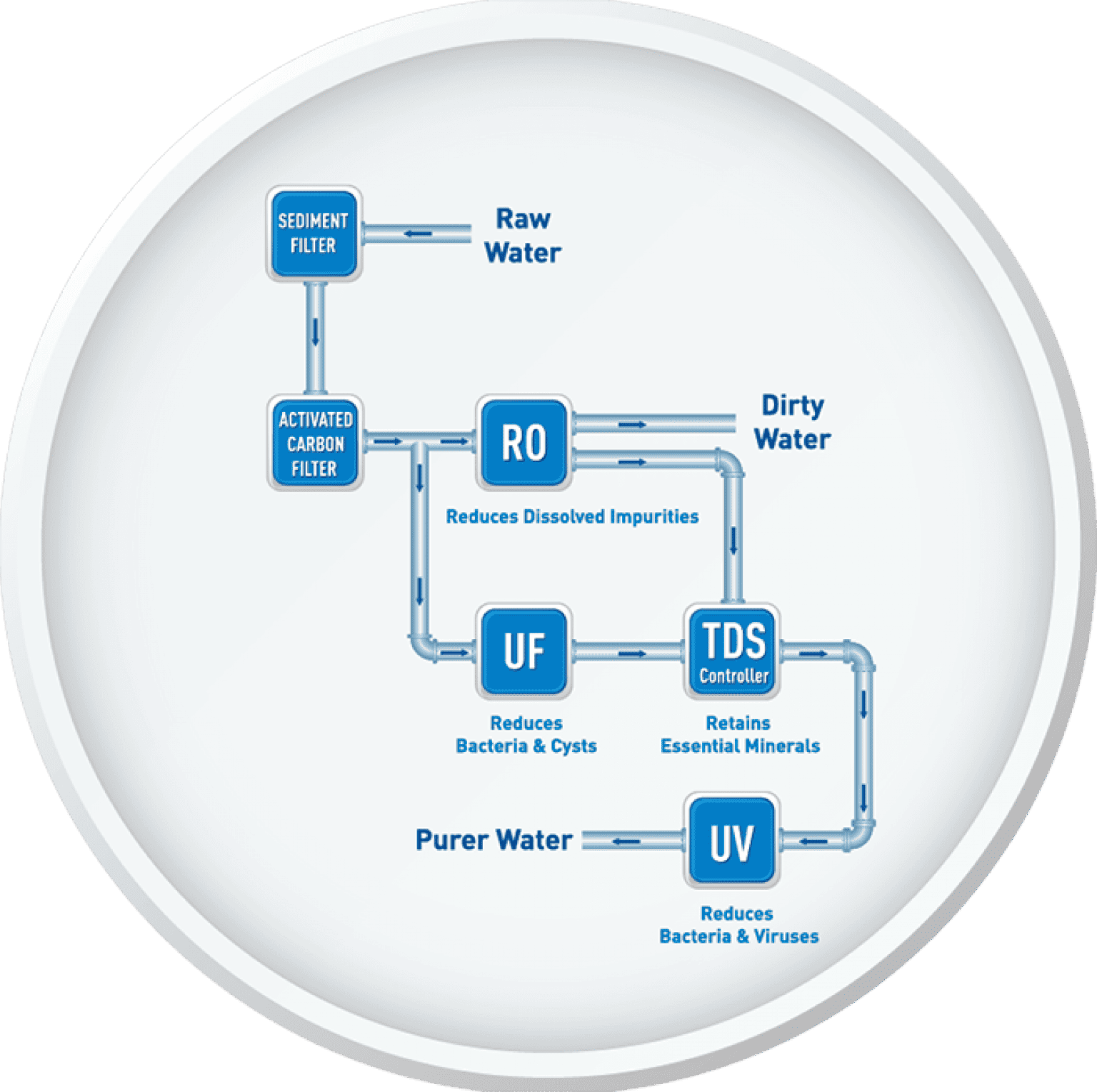
Sediment Pre-filter: In the first stage of purification, the input water is filtered using a pre-sediment filter. Pre-sediment filter not only removes fine and coarse particulate impurities/dirt but also improves the life of the RO/UF membrane resulting in a lower cost of maintenance. If the purifier does not include this as a standard feature then it can be added separately as well.
Activated Carbon Pre-filter: Activated carbon pre-filter removes chlorine and organic impurities like harmful pesticides from the water. Activated carbon pre-filter also adsorbs bad odor and taste-causing organic compounds from water.
RO/UF membranes: Water is fed into the RO membrane at high pressure using an in-built water pump. RO membrane removes the hardness, dissolved salts, pesticides, and heavy metals like lead, arsenic, and mercury. It also removes microbial contaminants like viruses, bacteria, protozoa, and cysts. The UF membrane also works like the RO membrane but it does not remove the dissolved solids. Some purifiers use both RO and a UF membrane, the output water from both membranes is mixed to control the TDS level of purified water.
TDS controller: The TDS controller is used for controlling the TDS level of the output water. RO process not only removes bad impurities but also removes essential minerals like Calcium and Magnesium. TDS controller retains adequate quantities of essential minerals in the purified water by adjusting the ratio of water from the RO membrane (low TDS) and UF membrane (normal TDS) in the final mix.
UV Filter: A UV filter uses a high-intensity UV bulb to kill or inactivate any virus, bacteria, and parasites to deliver safe water.
Carbon Post-filter: Carbon Post-filter acts as a polisher and enhances the taste of purified water. It also removes any foul smell from water.
Storage Tank: This stores the purified water for later use. Make sure the storage tank is made of food-grade, non-toxic material. Some of the high-end water purifiers now come with a stainless steel water storage tank. You should also check the capacity of the storage tank.
Display: Most of the RO water purifiers come with a basic display for on/off, tank full, etc. Some advanced purifiers also come with fault alerts, filter change alerts, UV fail, TDS level indicators, purity indicators, etc.
Gravity-Based Water Purifiers – Where Do They Fit In?
Good question. Considering they’re inexpensive and effective, it’s natural that these filters excite a lot of interest, especially among first-time buyers of water purifiers. Now, these filters don’t deliver advanced water purification capabilities such as RO and UV-based filters. So, the only scenarios where they become practical options are:
When you don’t have optimum conditions for the installation of an electric water purifier, such as optimum water pressure, electricity, and running water supply.
When you need to switch homes frequently and don’t want to have bulky equipment to move around and re-install every time.
When you have a very limited budget.
In such situations, you could either choose to buy purified water in bulk from a convenience store or install a gravity-based water purifier.
Installation Feasibility of Water Purifiers
Most RO and UV-based water purifiers are bulky and pretty heavy. Before you buy one, make sure you know of its dimensions, and have a plan to have it wall-mounted in the kitchen area. You will need to provide an inlet for electricity and another for water. Also, there must be a continuous water supply at decent pressure, particularly when the water purifier is mounted high on a kitchen wall.
Reducing and Reusing RO Waste Water
Avoid using an RO water purifier if the TDS level of the input water is below 500 mg/L and the water does not contain any harmful heavy metals like lead, arsenic, and mercury. In such a case, using a UV+UF water purifier would be more appropriate. Save water by not using RO water purifiers if RO purification is not necessary.
An average RO purifier wastes approximately 3 litres of water for every 1 litre of purified water. That means only 25% of water is purified and 75% of water comes out as waste.
Shocked?
It’s true. This high percentage of water wastage is a major cause of worry. If you are also using an RO water purifier at your home or office then we request you to follow the below-given tips to reduce the wastage of water and re-use the wastewater generated by RO purifiers.
If the output water from your purifier has very low TDS (less than 150) then it means your purifier is generating more wastewater. A very low level of TDS not only results in higher wastage of water but it is also bad for our health as it is devoid of essential minerals. Increasing the TDS will not only make drinking water healthier but also reduce waste. You can increase the TDS level of your water purifier using the TDS controller knob.
The sole and biggest criteria for deciding the type of water purifier you should buy are the source of water and the kind of impurities present in the water supplied to your home or office. Use the suggestions shared in this water purifier buying guide to buy a new water purifier for your home or office.